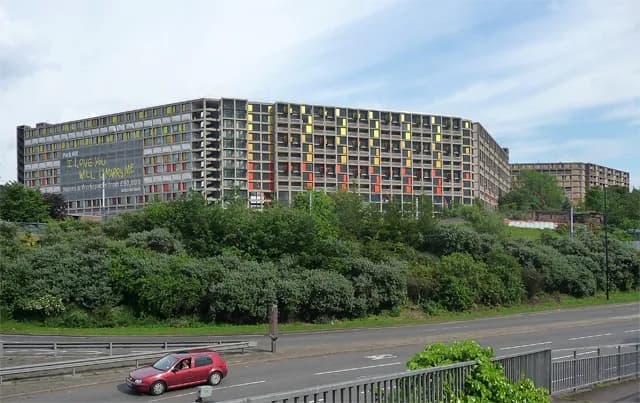
Park Hill remains the largest listed building in Europe and one of the most recognisable landmarks in Sheffield. Its history charts more than six decades of shifting ambitions for social housing, from post-war optimism through decades of decline to a painstaking regeneration that continues today.
From "Little Chicago" to a New Vision
The land that became Park Hill was once dominated by back-to-back housing so notorious for violent crime that locals called it "Little Chicago" during the 1930s. Sheffield's planning officer, G. C. Craven, recommended wholesale demolition, and the city's Medical Officer of Health, John Rennie, declared the dwellings unfit for human habitation because of disrepair, sanitary defects, and dangerous street arrangements. Clearance began in the 1930s, but it would be another two decades before a radical replacement emerged.
The "Streets in the Sky" Take Shape
Construction of Park Hill ran from 1957 to 1961, designed by architects Jack Lynn and Ivor Smith under Sheffield Council's City Architect, J. L. Womersley. The design drew inspiration from Le Corbusier's Unité d'Habitation and the unbuilt schemes by Alison and Peter Smithson for Golden Lane in London.
The estate rose on one of Sheffield's seven hills, south of the River Don and east of the River Sheaf, positioned upwind of the city's former industrial areas and immediately east of Sheffield railway station. The concept of "streets in the sky" meant access roadways ten feet wide on every third storey, broad enough for milk floats, with front doors opening directly onto them.
The structure used an exposed concrete frame with purple, terracotta, light red, and cream brick curtain walling. Part One was officially opened by Hugh Gaitskell, Leader of the Opposition, on 16 June 1961. The second phase, renamed Hyde Park flats, added four high-rise blocks with 1,160 dwellings and was opened by Queen Elizabeth the Queen Mother on 23 June 1966.
In total, the estate originally comprised 995 flats and maisonettes, three pubs, and 31 shops. To preserve community ties, neighbours were re-homed next door to each other and old street names were reused.
Grade II* Listing and a Fight for Survival
Initially, the flats were popular, offering private bathrooms and efficient heating. However, problems soon emerged. Parents found it difficult to supervise children in distant playgrounds, while unreliable lifts isolated older residents and were sometimes used as toilets.
Secluded walkways and stairwells contributed to crime and anti-social behaviour, and high balconies led to refuse and dangerous objects being thrown; a child was killed by a thrown television set in the late 1970s. Government restrictions on tenant allocation, decay of the building fabric, poor noise insulation, and security issues all accelerated the decline, and for many years the council struggled to find tenants.
In 1998, the estate was controversially granted Grade II* listed status in an effort to attract investment for renovation. It remains the largest listed building in Europe.
Urban Splash and the Long Road to Renewal
The renovation is being led by developers Urban Splash in partnership with English Heritage. The project aims to create a mostly private mixed-tenure estate, including homes for market rent, private sale, shared ownership, student housing, and social housing representing around a quarter of units.
Phase 1 began in 2009, stripping flanks A, B, and C to their concrete shells before rebuilding; the first homes opened to residents in 2010 and 2011. This phase was shortlisted for the RIBA Stirling Prize in 2013.
Phase 2 adopted a lighter touch, retaining original brick infill and the full width of the streets. Planning approval was granted in December 2017, work began in January 2019, and homes went on sale in February 2020, with residents moving in from January 2022. It includes 195 new flats and townhouses, commercial space, and the restoration of a link bridge.
The Pearl pub opened in September 2023. Phase 2 was also shortlisted for the RIBA Stirling Prize, this time in 2024.
Phase 3, developed as student accommodation under the name Béton House, provided 356 rooms in 74 townhouse-style units alongside communal spaces and a convenience shop; it was completed in autumn 2020 and students moved in that September.
What the Future Holds
Phase 4, covering flanks R, S, and T, received planning approval in August 2019 for 95 residential units, artist accommodation, heritage flats, artist studios, and a contemporary art gallery. An updated application in June 2023 removed the gallery due to lack of funding and included plans for car parks that proved controversial. A further amended application was approved in November 2023, and construction began in January 2026 with an expected build time of 106 weeks.
Phase 5, covering flanks I, J, K, and L, was submitted in June 2024 and approved in September 2024; it will deliver 105 residential units, commercial space, and a residents' allotment.
A Message in Neon
One of the estate's most famous features was a piece of graffiti reading "Clare Middleton I love you will u marry me," spray-painted by Jason Lowe in 2001. Urban Splash overlaid it in neon in 2008, but it was removed during renovation in early 2021.